Cornhole rules
Cornhole is played between two players or two teams who take turns pitching four bags each at a board 27 feet away. A bag through the hole scores 3 points, a bag left on the board scores 1, and only the difference between the two sides counts in each frame. The first side to reach 21 or more points at the end of a frame wins. Neither governing body uses a bust rule or requires winning by two.
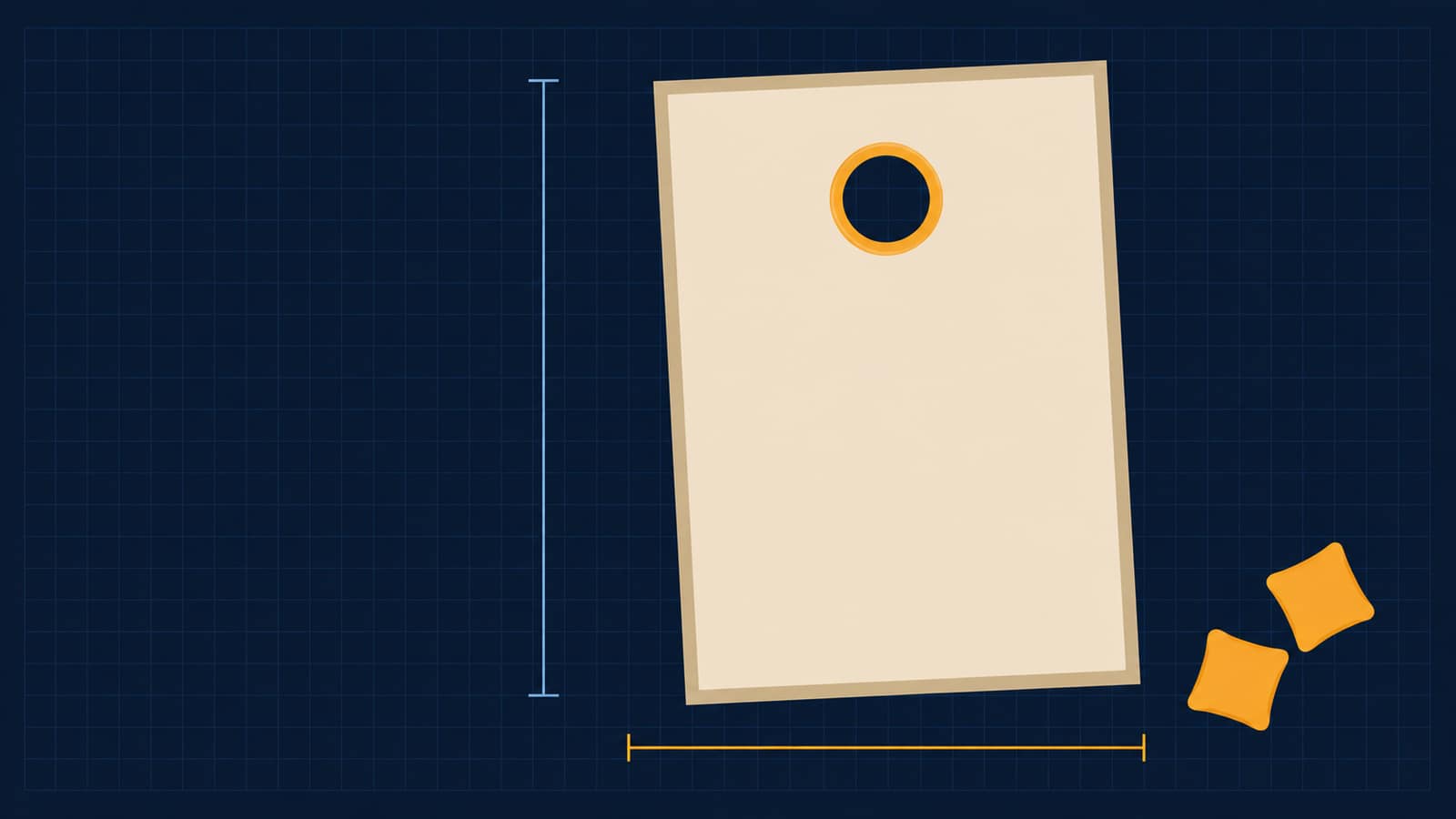
How to play cornhole, in one minute
The short version, for anyone who has a set in the garden and wants to start now. Everything below this section is the same game in full detail.
- Set the two boards 27 feet apart, front edge to front edge, on ground as level as you can find.
- Split into two players or two teams of two. Each side gets four bags of one colour.
- Take turns pitching one bag at a time at the opposite board until all eight are thrown. That is one frame.
- Score the frame: 3 points for a bag through the hole, 1 point for a bag resting on the board. A bag on the ground scores nothing, even if it touched the board first.
- Cancel the scores against each other, so only the side that scored more in the frame gets any points at all, and only the difference.
- The side that reaches 21 wins. Whoever scored last frame throws first in the next one.
That is the whole cornhole game as most people play it. The detail worth knowing after that is what counts as a foul, what happens if you go past 21, and where the ACL and the ACO disagree, all of which are set out below.
Setting up and starting
Two boards face each other 27 feet apart, front edge to front edge. In doubles, teammates stand at opposite ends and pitch toward each other; in singles, both players stand at the same end and walk to the other after each frame.
Place the boards 27 feet apart
Measure front edge to front edge, since the low ends face each other. Shorten it to 21 feet for children or a small garden, bearing in mind that only 27 feet is official.
Choose sides and lanes
In doubles, each team puts one player at each end. Every player stays in the same lane, left or right, for the whole game.
Decide who pitches first
The ACL settles the first frame with a coin toss, and the winner chooses whether to pitch first. After that, the side that scored in the previous frame pitches first in the next one.
Pitch four bags each, alternating
The two players at one end alternate single bags until both have pitched all four. Your feet must stay behind the front edge of the board you are standing beside. The ACO requires an underhanded release; the ACL permits underhand or overhand.
Score the frame, then pitch back
With all eight bags thrown, work out the score using cancellation scoring, clear the board, and pitch back the other way. Each pass is one frame.
Play to 21
The first side with 21 or more points at the END of a frame wins. A frame is always completed, so you cannot win partway through one.
What counts as a legal throw
A pitch is legal if your feet are in the right place when you release, and you throw within the time allowed. Whether you may throw overhand is the one point on which the two governing bodies flatly disagree.
| Body | What it says | So an overhand pitch is |
|---|---|---|
| ACO | "Players must deliver the bag with an underhanded release." | A foul |
| ACL | "The pitch of a cornhole bag may be underhand or overhand." | Perfectly legal |
Almost every page written about cornhole states that the bag must be thrown underhand. That is true under ACO rules and false under ACL rules, which say in as many words that a pitch "may be underhand or overhand". In practice virtually everyone throws underhand because it is far more accurate over 27 feet, but if you are settling an argument, the answer depends on whose rules you are playing.
- The foul line is the front edge of the board you are standing beside, not a separate line drawn on the ground.
- The ACL requires at least part of one foot to be inside the pitcher’s box, touching the ground, and not across the foul line at the moment of release.
- Under ACL rules you must not step on or beyond the foul line until the bag has landed at the other end. Stepping over immediately after release is still a foot foul, because the line holds until the bag makes contact.
- Both bodies allow 15 seconds per bag. The ACL measures it from the moment the opponent’s bag comes to rest, and allows longer for the first pitch of a round: 45 seconds in doubles, a minute in singles.
- You must pitch from the side of the board you were assigned, and stay in that lane for the whole game.
A foul bag is removed from play before the frame is scored. Crucially, the damage it did on the way through is NOT undone: the ACL states that where a dead bag causes other bags on the board to move, "the final resting places of the bags in play will count". You do not put the disturbed bags back. This is the opposite of what most people assume, and it is worth settling before the argument starts rather than after.
Which bags count
A bag scores 3 if it went through the hole at any point during the frame, 1 if it is resting on the playing surface when the frame ends, and nothing at all if it is touching the ground.
| Where the bag ends up | Points | Note |
|---|---|---|
| Through the hole | 3 | Counts even if another bag knocked it in |
| Resting on the playing surface | 1 | Called a "woody" |
| Hanging in the hole but not through | 1 | Scores as on the board, not as a cornhole |
| Touching the board and the ground | 0 | Explicitly worth nothing under ACO rules |
| Bounced off the ground first, then landed on the board | 0 | A "dead bag", removed even though it is on the board |
| On the ground, or thrown as a foul | 0 | Removed before scoring |
The ground-touching rule settles the most common argument in the game. A bag that has slid off the front of the board and is resting against it, touching both the board and the grass, scores nothing. It is not a woody. The ACO states this explicitly.
The other frequent dispute is a bag knocked into the hole by a later throw. It counts, and it counts for whoever threw it. The ACO defines a cornhole as any bag that "passes through the cornhole board hole at anytime within the frame", so how it got there is irrelevant. Bags are scored on where they finish, which is why deliberately knocking an opponent’s bag off the board is a legitimate and common tactic.
A "dead bag" is the one most people have never heard of. Under ACL rules, a bag that touches the ground or any other surface BEFORE it touches the board is worth nothing and is removed, even if it bounced up and came to rest neatly on the playing surface. A skimmed bag that hits the grass short of the board and skips on is not a woody; it is dead.
And if a dead bag knocks other bags around on its way through, those bags are NOT reset. The ACL is explicit that "the final resting places of the bags in play will count". The bag that caused the mess comes off; the mess itself stands.
One more that comes up with a full board. Under ACL rules, if a hanging bag is touching a bag already in the hole, the bags in the hole are swept out from underneath without disturbing the hanging bag. The sweep is done by an official, or failing that by an unbiased spectator or the least-benefited player. The rule does not say what happens next, but in practice the hanging bag loses its support and falls through, scoring 3. The ACO has a matching provision letting a player request a rake when bags pile up inside the hole and might obstruct the next pitch.
Cornhole terms
Cornhole
- A bag that passes through the hole in the board at any point during the frame. A cornhole is worth 3 points, and it counts whether it was thrown in directly or knocked in by a later bag.
Woody
- A bag that has been pitched and remains resting on the board’s playing surface when the frame ends. A woody is worth 1 point. A bag touching both the board and the ground is not a woody and scores nothing.
Frame
- One complete round of cornhole in which all eight bags are pitched, four by each player or team, and the score is then worked out. A game is a sequence of frames played until one side reaches 21 or more points.
Cancellation scoring
- The standard method of scoring cornhole, in which the two sides’ points in a frame cancel each other out and only the difference is awarded, to the higher-scoring side. It means only one side can score in any given frame.
Wash
- A frame in which both sides score the same number of raw points, so everything cancels and neither side adds anything to its total. The side that pitched first in a washed frame pitches first again in the next one.
Dead bag
- A bag that touches the ground or any other surface before it touches the board. Under ACL rules a dead bag scores nothing and is removed, even if it bounced up and came to rest on the playing surface. Any bags it knocked out of position are NOT put back. They are scored where they finish.
Hanger
- A bag resting on the edge of the hole, partly over the opening but not fallen through. A hanger scores 1 point as a bag on the board, but it usually drops in when the board is next struck.
Blocker
- A bag deliberately left on the board in front of the hole to stop an opponent sliding a bag in. Blocking is a standard tactic rather than a rules concept.
Airmail
- A bag thrown high and directly into the hole without touching the board first, usually to get past a blocker. It scores 3 points like any other cornhole.
Slider
- A bag thrown flat and low so that it lands on the playing surface and slides up into the hole. The usual alternative to an airmail when the front of the board is clear.
Pitcher’s box
- The area a player must throw from, positioned beside the board at their end of the court. The ACO specifies a box 4 feet by 3 feet at each end of the court on both sides.
Foul line
- The line a player’s feet must stay behind when releasing a bag. Both governing bodies define it as the front edge of the board the player is standing beside, rather than a separate line marked on the ground.
Skunk
- A house rule that ends the game early if one side reaches a set lead, commonly 11 to 0, while the opponent has not scored. No governing body recognises it.
Printable rules and score sheet
A one-page rules card for the shed or the cooler lid, and a score sheet for keeping frame-by-frame totals on paper.
- Cornhole rules card (PDF): One page: setup, scoring, fouls and the disputed calls. Free to print and share with attribution.
- Cornhole score sheet (PDF): Frame-by-frame sheet with running totals and space for four games.
Common questions about the rules
How do you play cornhole?
- Two sides take turns pitching four bags each at a board 27 feet away. A bag through the hole scores 3 points and a bag left on the board scores 1. The two sides’ points cancel each other out, so only the difference is awarded, and the first side to reach 21 or more points at the end of a frame wins.
Do you have to get exactly 21 to win cornhole?
- No. Both governing bodies play to 21 or more. The ACO rule sheet says games are played to "21 or more points (no bust)", and the ACL states that a team "is not penalized for achieving a score over 21". Going back to 15 on overshooting is a popular house rule, not an official one.
Do you have to win cornhole by two points?
- No. Neither the ACL nor the ACO requires a two-point margin. Reaching 21 at the end of a frame wins the game regardless of the opponent’s score. Win-by-two is a house rule borrowed from other games.
Who goes first in cornhole?
- The first frame is decided by a coin toss under ACL rules, and the winner chooses whether to pitch first. After that, the side that scored in the previous frame pitches first in the next one. If a frame is a wash, whoever pitched first keeps it.
Does a bag knocked into the hole count?
- Yes, and it scores 3 points for whoever threw it. Bags are judged on where they end up at the end of the frame, not on how they got there, which is why knocking bags around is a normal part of the game.
Does a bag touching the ground count in cornhole?
- No. The ACO states that a bag resting against both the board and the ground does not count as a point, even though part of it is still on the playing surface. It is removed with the rest of the bags at the end of the frame.
Does a bag count if it bounces off the ground onto the board?
- No. Under ACL rules a bag that touches the ground or any other surface before touching the board is worth 0 points and must be removed, even if it bounced up and came to rest neatly on the playing surface. This is called a dead bag, and it is the rule most casual players have never heard of.
If a bag bounces in and knocks other bags around, do you put them back?
- No. The ACL states that where a dead bag causes other bags on the board to move, "the final resting places of the bags in play will count". The offending bag is removed, but the bags it disturbed are scored exactly where they ended up. Most people assume the opposite.
Can you throw overhand in cornhole?
- It depends whose rules you are playing. The ACO requires an underhanded release, so an overhand pitch is a foul. The ACL explicitly permits it: its rules state that a pitch "may be underhand or overhand". Nearly everyone throws underhand anyway, because it is far more accurate over 27 feet.
Is stepping over the line after you throw a foul in cornhole?
- Yes, under ACL rules. A player may not step on or beyond the foul line until the pitched bag makes contact with the board or the ground at the other end. Releasing the bag first does not make it legal to step across straight away. The line holds until the bag lands.
Sources
This page follows the American Cornhole League’s Rules and Regulations and the American Cornhole Organization’s official rule sheet, both read on 4 August 2026. Where a common practice is not in either document, as with the skunk rule, bust and win-by-two, it is described on this site as a house rule and kept on the variants page rather than presented as part of the rules.